Showing posts with label pebbles. Show all posts

Tuesday, February 14, 2023

So many projects on the go!

Welcome! Have you ever felt like your quilting life is out of control? Since finishing Version 2.0 I have been working on more and more projects. Some are classes, others are my usual TextileArtist.org workshops and then there are those squirrel projects from who knows where. 😃

2023 Stitch Camp


This year's Stitch Camp at TextileArtist.org was a revised version of the Gwen Hadley workshop from June 2021. Since I hadn't done the original workshop, I thought that I would give this version a go. TextileArtist.org does an amazing job with their workshop and Gwen Hadley is very popular. I just hadn't participated because I had tons of other projects on the go and it involved paint. I am getting more comfortable mark making with paint but it's not my favourite thing to do. I do like how it came out.

First cloth is heavily marked

The first cloth is heavily marked, half in one colour and the other half in the second colour. We added little bits of the "other" colour in each half. I used many tools for mark making, including the bottom of a plastic insert from an assorted box of crackers.  

Second cloth has more background showing

We used the same colours for the second cloth but applied the paint marks sparingly. I used many of the same tools but added a plastic fork as well as the end of a swimming noodle. For both pieces I used Pebeo Setacolor  - a shimmer opaque turquoise and a glitter tourmaline (purple/fuchsia). I figured that they would play nice together 😊

The next step is to cut these two cloths up and join then back together with stitches, appliqué, etc. The suggested project is to stitch together a long narrow band such as a snippet roll. For this project, I would rather make an art piece that I can attach to a canvas frame. 

Starting to put some stitches in to blend the pieces

I've put everything together (i.e. fabric, yarn, thread, etc.) to work on the project. This is the best way that I've found to keep ongoing projects. Every once in a while, if I find something that could be used for the project, I just add it to the bag.

My project so far.


Rocks, Pebbles & Stones, Oh My!


The Rocks, Pebbles & Stones, Oh My! workshop was taught by Ana Buzzalino, through the Craft Napa 2023 Uncorked at home (virtual). When I saw the images for the course, with those rocks attached to her art quilt, I was hooked.

Ana is a great teacher and her work is wonderful. We learned 3 techniques for making and attaching rocks to our work. The first is to use the background fabric to make the rock, sort of like trapunto. For me this was the easiest technique to use.  

My project so far

I found an amazing piece of painted fabric in my stash. In the picture above I've covered the top sections with different blue fabric since I want it to be more of a water and beach scene. 

Here are some of the photos of my trapunto-like process of making rocks and pebbles. For this technique, it was easiest to work with the padding and background fabric within an embroidery hoop, underneath the top fabric.

Adding the batting over the back

Stitching the first rock

Keeping the fabric as tight as possible and having as little gathering fabric as possible was difficult. To hide these pleats, I'll be adding beads after the rocks are finished. This covers up the pleats, looks like sand and gives a wonderful effect.

Pinning the fabric to stitch a second pebble

Three rocks or pebbles imbedded within the piece

We learned two other methods of making rocks or pebbles. The first is to create a flat stone using a cardboard  template while the other used more batting and stiff interfacing. These can then be attached by appliqué to the piece. Again the most difficult part is getting rid of pleats because rocks don't generally have them 😁

A collection of stones on a partly FMQ background


Card featuring a Meditation block


A couple of weeks ago I needed to send a card. Since I have lots of blank cards and envelopes in my stash, I though that it might be the time to see what I could make.

Hand-made card using a Meditation block

I attached my favourite meditation block with natural elements to make the card. I stitched the corners of the block into the paper to attach it. I really like how it turned out. This is a great way to use meditation blocks.
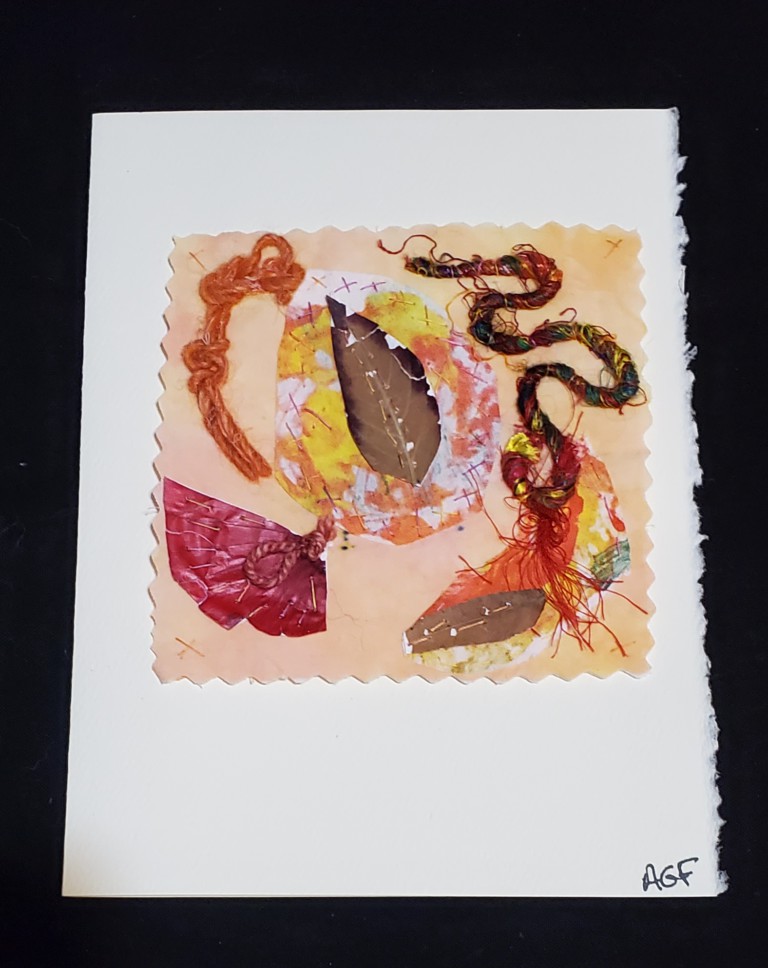
Card with natural elements


What I learned

Stitch Camp
  • I enjoyed the mark-making process in Gwen Hadley's workshop. 
  • There was also no pressure to make it look great since it would be cut up.
  • When cutting the fabric, I was nervous because the fabric's weave is quite open. I think that the paint kept it from fraying too much. Besides, I'm sure that I'll be adding some frayed bits for effect!😊
  • A week was not enough for me to get this workshop done but then I always take it further, and of course having all of these projects on the go isn't helping. 
  • I've arranged all of the materials in a lovely bag that I can grab at any time. This one is coming with me on holidays. I just need to ensure that I have some good contrasting thread and material so that things don't all blend into a puddle!
Rocks, Pebbles and Stones
  • The first thing that I learned is that I need to read course descriptions better before signing up! When I saw the images of Ana Buzzalino's art pieces, I had no idea that the stones were made of fabric - they are that good! So, I though that I was going to learn to attach stones to art quilts, not make the stones! 😁
  • I'm not sorry that I took the course. I did learn new techniques and the teacher was terrific, but it's going to require a lot of practice before my stones look like the real thing.
  • I'm not sure what I want to do as a finished piece. I will be adding shells and driftwood with embroidery, like I did in the Embroidered Seascape workshop (see link below). That would be very cool, but I'm not quite ready to tackle that yet. One day inspiration will crash into my consciousness!
Card featuring Meditation blocks
  • I'll be making more of these and playing with that concept!
  • I'm not sure how the card survived the postal service - I hope that the recipient didn't end up with a bunch of crumbled bits at the bottom of the envelope. I'll have to work on that if they are going to be mailed!

Related links
Linking parties


Project details


Card with Meditation block - Natural Elements
Meditation block made based on Claire de Waard's workshop
Card size: 5" x 6⅞"
Material: Meditation block made with fabric, sari yarn, painted fabric, thread, yarn and leaves and onion skins glued to paper; card is ivory with deckle on acid free paper
Techniques: embroidery and stitching


Monday, March 16, 2015

FMQ Madness!

I once blogged that there might be such as thing as too much of a good thing - that is, free-motion quilting (FMQ). Now I'm not so sure. Since I've gotten better at it, it's become incredibly addictive. I'm not sure that I'll ever be able to just stitch-in-the-ditch or do some minimalist quilting. It doesn't mean that every inch of every quilt needs to be quilted. It still depends on the quilt; its design, use, etc. I'm just saying that it's really, really difficult to not keep going when you're FMQ.

I can safely thank (or blame) Cindy Needham. I have taken both of her Craftsy courses and have watched them both a number of times. Design It, Quilt It: Free-Form Techniques has some great tips on FMQ. The one that got me though, is Machine Quilting Wholecloth Quilts. This course is about creating Wholecloth quilts (basically from one piece of fabric as opposed to a pieced top). Since most of the quilts are just one colour, which means ample opportunities to FMQ.

Her incredible quilts are usually made of vintage linens over plain cotton or silk fabric. Cindy clearly loves her vintage linens and incorporates them on wholecloth quilts while highlighting the original creator's work. This is all beautiful and truthfully, a little intimidating. So, instead of starting with a wholecloth quilt made of linen, I've started with a project that was less intimidating but that let me FMQ like crazy. It's creating a wholecloth quilt from large print fabric. You use a fabric that has interesting shapes that would be fun to quilt, and you quilt it from the back. Let me explain.
The fabric you quilt on becomes the back of the quilt

Here's the fabric that I chose. It's got all kinds of interesting shapes that would be fun to quilt. I created a quilt sandwich with some lovely light yellow-orange fabric. I chose a couple of threads that would go well with the fabric. I used a thicker thread to outline the shapes while the other finer thread was used for the scribbling and other FMQ shapes such as pebbles, straight lines, S-curves and feathers.
Large print wholecloth quilt


All of the quilting is done on the front of the large print fabric. The beauty comes when you look at the other side! Isn't it amazing that quilting that rather gaudy fabric could create a piece of such simplicity and elegance?

This technique is perfect for quilting with metallic threads. These can be very finicky to quilt with unless they are in the bobbin. Since this project is quilted from the back, it highlights all of the bobbin thread. As you can see from the photo, the flowers were quilted with the metallic thread, sometimes 3 or 4 times so that they will show up.

Here are images of some of the details. The metallic thread and the beading add an elegant touch. You can see the scribbling, pebbles and feathers between the outlines of the flowers and leaves.
Details

More details of metallic thread and beading


What I learned:

  • Quilting from the back of the quilt took some getting used to but what an end-product! I couldn't wait to take it out to see the results.
  • I've since tried to work with metallic thread that was not in the bobbin. What a mess!
  • This was a great project to practice FMQ. There was TONS of FMQ and you can't tell from the end product if you followed the lines or not!
  • I suspect there will be a few more of these wholecloth large print wall hangings since they were sooooo much fun to work with.
  • I may be ready to work with some linens. I'll start with hankies that I picked up in China. At least if doesn't turn out as well as I'd like, I won't have destroyed a vintage piece!
I linked up to Free Motion Mavericks. Have a look!

Friday, September 12, 2014

Re-quilting a Door Hanging

About 3 years ago I made my first door hanging. I wanted something on the door that wasn't a wreath - it was either make something or repaint the door (in other words, a no-brainer!) I started with four different panels and incorporated various elements from magazines etc. I found some lovely appliqué of flowers and a Canada goose, so I decided to work around these.

Since the hanging would be used in the summer, I chose a white background and lighter colours. The bottom-left panel had the flowers appliqué while the top-right had the Canada goose. I made a block for each of the other panels. The bottom panel had a basket block with flower fabric while the top block was a star with evening colours. I added a star above the goose and embroidered our last name underneath it (I didn't want anyone leaving with it!)

Original quilting
Original quilting
That was the extent of my door hanging. I had very little experience machine quilting so I did a little bit of stitch in the ditch and a few wavy lines here and there and called it done.

When I made that first door hanging, my intention was to have one for each season. This summer I finished my second, spring door hanging. I had learned many lessons about door hangings by then, so it wasn't white, but rather bright pink, green and orange. Nothing calm about that one!

As I've mentioned in my last post, the quilting I do depends a lot on the amount of energy I have in the evenings and on weekends. Low energy this summer has meant that I have watched many Craftsy courses. The one that has inspired me the most lately has been Cindy Needham's Design it, Quilt it: Free-Form Techniques. Since I'm always looking for projects to practice my free motion quilting (FMQ) on, I took out that first door hanging. I had nothing to loose. That door hanging had served me well for two years, so if I messed it up, it wasn't the end of the world.
Stencil for the basket

I really wish I had taken a before picture. In the photo above, the lines represent roughly the original quilting. As you can see, it was pretty sparse - I just didn't know what to quilt.

In the re-quilting, I started with stencils. I used a border flower stencil for the bottom-left side. I added a flower stencil on the basket and then a sun, two stars, a fleur-de-lys and a diamond pattern in the top-right.

Here is some of the FMQ I did:
FMQ using stencils, lines, echoing and swirls

  • I added echoing around the flowers, dragonfly, the Canada goose and the star. They had already been bordered but the echoing is much more effective. 
  • I worked with the original straight lines above the flowers and added more. 
  • Swirls were added around the basket as well as to the left of the Canada goose.
  • I scribbled in the white triangles and squares within the basket as well as around the embroidery. That provided lovely contrast.

That filled in most of the space. I really didn't know what to do with the rest of the background, so I watched the Background chapter of Cindy Needham's video once more. I figured out that I had to block off the areas that were still blank and work each one separately. Breaking down the area really helped.
FMQ pebbles within S curves and Dot-to-Dot quilting

I also practiced drawing the swirls and the pebbles a lot, so that by the time I started FMQ, my hand muscles knew exactly what to do. As Cindy suggested, I also used my fingertips to guide the FMQ - that was extremely helpful.

For the star block on the top-left, I used that trusty dot-to-dot from Angela Walter's Dot-to-Dot quilting technique. I didn't want to distract from the design, especially for the windmill in the middle of the block.
Re-quilted door hanging

What I learned:


  • I thought that I would really dislike making repetitive designs such as swirls and pebbles. It was very tedious before I got the motion down, but after that, it was really enjoyable and very Zen. Not at all what I was expecting!
  • A WHITE door hanging is NOT a good idea. I knew that it would be subject to the elements, but I didn't realise that it might blow away and land in the garden. Darker or brighter colours are much better suited to door hangings.
  • I am very happy with the results. The only thing I would do differently the next time is to plan out the stencils a little more. Most were fine, but I overdid it in the top-right panel.   
  • Cindy Needham says that we should have movement, depth, and light and shadow in our quilting. I think I'm getting there.
I shared this post at Sarah's blog, Confessions of a Fabric Addict for her Whoop Whoop party! and Link-A-Finish Friday with Richard and Tanya Quilts. Check out the fun.