
I've just finished a genuine Squirrel! Saw the project online, found the pattern maker, bought the pattern December 12 and finished it today, December 28! Getting a whole project done that quickly is not something I do often 😊
Learning a modern version of Pojagi
In the rabbit hole that is the internet, I found Elizabeth DeCroos. She is an Island Batik Ambassador (which is how I found her). She also has developed some great project patterns and videos about using a modern version of pojagi to make what look like stained glass window hangings. They are absolutely stunning!
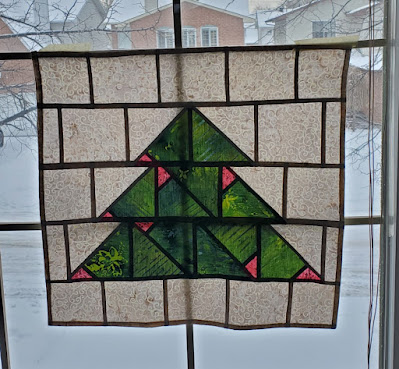 |
| Finished Christmas Tree Window Hanging |
After some research, I got pretty confused. The terms pojagi and jogakbo are sometimes used interchangeably. Pojagi is a traditional Korean wrapping cloth made from scraps of left-over fabrics. From the Victoria and Albert museum, it sounds like jogakbo is a patchwork pojagi. There were many websites and YouTube videos of some stunning examples of pojagi and jogakbo. I've included a few of these in Related links below.
I took a workshop last year that used translucent fabrics (silk organza) that are sewn by hand to make a light catcher. I never actually made one because the videos were available for a very short time and sewing silk organza by hand seemed beyond me at the time.
When I found Elizabeth DeCroos' website and saw that she made pojagi using a sewing machine and batik fabric, I was totally intrigued. I bought her Christmas Tree Window Hanging pattern and actually chose my fabrics and started cutting them that same night.
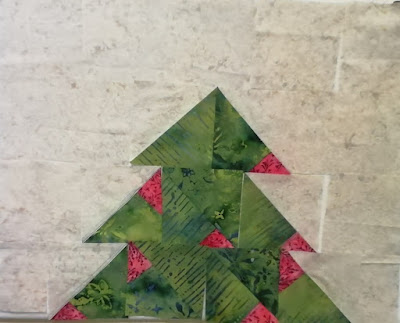 |
| Fabric cut and half-square triangles made and pieced |
I started by watching her Question and Answer video on YouTube, "Getting started making stained glass window hangings (all the FAQs)". This was very informative and gave me the confidence to jump right in. I then watched her "Modern Pojagi Simple Seam Tutorial". From there, I was able to start piecing the half-square triangles and the squares together. Once I had watched her video, I was then able to refer to her pattern to refresh my memory.
 |
| Attaching all of the squares together in rows |
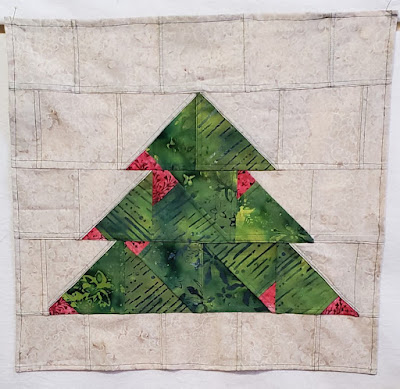 |
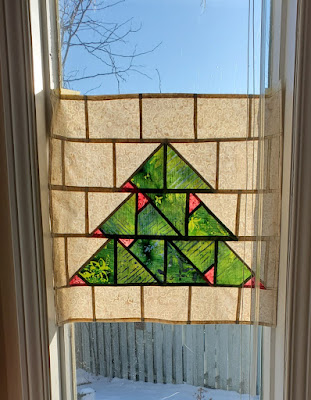
| The finished Christmas Tree Window Hanging using modern pojagi simple seams and the regular pojagi seams |
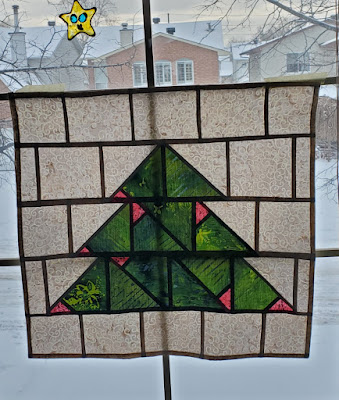 |
| Hanging in the window |
 |
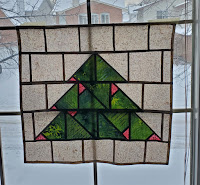
| The sun is shining! |
- This was an easy technique to learn. Elizabeth has other patterns that look more complicated but I really love the simplicity of these squares and half triangles.
- When I first tried both of the pojagi seam techniques, I followed all of the steps. I used my ¼" ruler to check my seams throughout the whole process. However, after making a few seams, I was able to leave out all of the ironing. Batik holds its fold well and I didn't need to press the seam once I was used to the process.
- To make the regular pojagi seam, I used my walking foot for the last stitched part over all of the fabric. It worked wonderfully.
- In her first Q&A video, Elizabeth warns us to let go and have fun. The beauty of the work is in it's uniqueness and that perfection is not needed. She says that if we really must have all of the single and double stitched lines together, to have our seam rippers handy. She's totally right and it was great not to worry about these details. In the end, when the hanging is in the window, you don't see the seams. You just see the beauty of the fabrics.
- Elizabeth also has instructions for the traditional hand stitch used in traditional pojagi. I will probably try that at some point.
- When I did my research to write this post, I found some amazing art done with the jogakbo or pojagi technique. They are listed below in Related links. They are short and well worth looking at.
- Elizabeth DeCroos, Epida Studio
- Getting started making stained glass window hangings (all the FAQs) on YouTube
- Modern pojagi simple seam tutorial on YouTube
- Regular pojagi seam tutorial on YouTube
- Traditional pojagi tutorials
- EpidaStudio's pojagi patterns
- Great videos on YouTube of jogakbo, or patchwork pojagi art
 |


